Bossaball is a combination of bouncing on a trampoline with volleyball.
The bossaball might be dangerous because they can fall down and they can be seriously injured sothey usenetsto protect themselves.
Two teams, mode up of three to five players, are allowed to touch the ball to the other team. If the ball touches any other part or the court, the team gets one point.The game continues, with the first team to score 25 points (and be two points ahead) awarded the set. Three sets are played in one match.Any body part can be used. Players can touch the ball only once with their hands, or double touch it with their feet and/or head.
Lawnmower racing is a form of motorsport in which competitors race modified lawnmowers, usually of the ride on or self-propelled variety. Original mower engines are retained, but blades are removed for safety. The sport attracts all ages, and is usually entered into in a spirit of fun rather than extreme competitiveness, though many do take it quite seriously.
Lawn mower racing was started back in 1973 by an Irishman called Jim Gavin. Jim was heavily involved in rallying and like all motorsport at this time, sponsorship was creeping in. Jim didn’t really like this and wanted to create a form of motorsport that didn’t involve lots of money and was readily accessible to everyone. they realised that everyone had a lawn mower in their garden shed so they said “let’s race them”, and they did.
Best players:
Bobby Cleveland - set the land speed record for the World’s Fastest Lawnmower on July 4, 2006 at the Bonneville Salt Flats in Utah, receiving international media coverage. The most important nationalities are North Carolina, Australia and Englad(who is the best in this sport). Others drivers are Kenneth Pioch(is the oldest driver whith 84 years old) and Jodie Grimes (36 years old).
To enter any race meeting you must be a member of the BLMRA, have had your mower homologated, stamped and been issued with a log book and race number.
Some tournaments are:
THE BRITISH CHAMPIONSHIP (The British Championship takes place from May to October.) Events not part of the Championship are: any ENDURANCE EVENT( The 12 hours endurance race and the 3 hours endurance race), BRITISH GRAND PRIX, WORLD CHAMPIONSHIPS. Other tournament is CROSS COUNTRY CHAMPIONSHIP.
Recently, the folks at Team Runningblade in England have challenged the world record of 80.792 mph.
Official rules:
-Driver Eligibility Drivers must be members of the U.S. Lawn Mower Racing Association or must race as part of a sanctioned USLMRA Affiliated Club (AC). Drivers must be 18 years of age. Drivers 8-17 years of age can race with parental permission. All drivers must sign a release discharging the USLMRA from liability. -Mower Eligibility Events are open to all self-propelled rotary or reel style riding lawn mowers. The mower must originally have been designed and sold commercially to mow lawns. It must remain suitable for lawn cutting, apart from the modifications permitted in the Handbook. -Technical Inspection Every mower entered in any USLMRA event must be approved for competition by Technical Inspection. Any mower may be re-inspected at any time by the Chief Steward or Chief Technical Inspector. -Mower Requirements CUTTING BLADES MUST BE REMOVED COMPLETELY FROM ALL MOWERS. Non-stock mowers must be equipped with an automatic throttle closing device. All mowers must be equipped with an engine safety cut-off switch. Mower brakes must be in good condition, operating on at least 2 wheels. Fuel must be pump gas. The only additive allowed is STA-BIL Fuel Stabilizer. -Driver Safety Equipment Every driver must wear an automobile racing or motorcycle-type safety helmet. Every driver shall wear long pants, a long-sleeved shirt, gloves and shoes on the track. It is MANDATORY that all drivers wear an “approved for racing” neck support. -Rider Mower Classification Stock Class: As delivered from the factory. IMOW Class: (Int’l Mowers Of Weeds) Front engine, highly regulated. Prepared Class: Prepared (modified) drive train, engine, etc. FX Class: Major modifications allowed. JP Class: Class for kids ages 10-15. -U.S.Open Events U.S. Open Kids Stock (5mph max) U.S. Open Super Stock (Un-Governed Single Flat Heads and Shiftable Transaxle or Transmissions only) U.S. Open Single U.S. Open Twins
Buzkashi is a game that dates itself into Afghan antiquity. The name Buzkashi, literally translated means "goat killing" suggest it was derived from hunting mountain goats by champions on horseback. Today the rider (or team) who is able to pitch a dead calf across a goal line first wins. The game may last as long as a week and is as free-wheeling as the Afghan spirit. Headless carcass of calf or goat is kept in the center of a field. Players of two opposing teams try to get hold of the carcass and carry it to the goal area. This is not a simple task and requires great skills. Novice players cannot even get close to the carcass. The game continues until a team is announced the winner. Winner of the match receives prizes ranging from money, fine turbans and clothes.
It is believed that Buzkashi began in Afghanistan with the arrival of Turkic-Mongol people from steppes. They domesticated horses and used them for riding, carrying loads and hunting animals. Particularly they were fond of hunting mountain goats while riding their horses. Gradually it became a regular and popular game in the region.
There are two types of Buzkashi:Tudabarai & Qarajai In Tudabarai, in order to score, the rider must obtain possession of the carcass and then carry it away from the starting circle in any direction. The rider must stay free and clear of the other riders. In Qarajai, the task is much more complex. The player must carry the calf around a marker, and then return the carcass to the team's designated scoring circle.
In each version of the game, points are awarded for successfully completing the task of getting control of the carcass, and getting it to the proper scoring area. The winner of each match receives prizes which have been put up by a sponsor. The top prizes are usually money, or fine clothes.
To many Afghans, Buzkashi is not just a game, it is a way of life; a way in which teamwork and communication are essential to being successful. Buzkashi is a sport which is only played in Afghanistan and China(there is not only horse-back Buzkashi, but also yak Buzkashi among Tuziks).
There are no worldwide buzkashi competitions, provincial tournaments are realise in the desert areas of the country or in specific venues. In China there are specific venues for this sport.
RULES:
The Afghan Olympic Federation has established official rules for Buzkashi. They are strictly observed, however, only for contests in Kabul. In the Northern provinces, Buzkashi is seldom played according to "official" rules. There is no limitation on the size or type of the field and as many as 500 riders may participate in one game. Possible variations on the game include a free-for all in which the individual riders comprise one-man teams, and "darya-yi-Buzkashi" which is played in the middle of a river or stream. There are, however, two rules which apply to every Buzkashi contest. A rider may never hit an opponent intentionally with his whip, and he may never deliberately knock an opponent off his horse. Buzkashi literally means "goat dragging," but a decapitated calf is now used because it is stronger and heavier, and therefore able to withstand the punishment of the game. The carcass is soaked in water overnight to toughen the hide. The Olympic Federation's rules require the field to be a square, the outer boundary of which is 400 metres on a side and the inner boundary, or warning line, 350 metres on each side. Two circles are drawn on the playing field.
The game begins at the starting circle with the penalty lines (the inner boundary) used only when the mounted referee has called a foul. The object of the game is to drop the calf into the scoring circle. Two points are scored for each goal. At one end of the field stands a line of flags marking the minimum distance the calf must be carried before returning to the scoring circle to make a goal. A team crossing the line of flags receives one point. For championship Buzkashi in Kabul, teams are limited to ten riders each. Five players take the field during the first 45 minutes of play; the other five compete during the second period. A field master presides over the match and has the authority to prolong the game and grant permission for a change of riders or horses. The halftime break lasts for 15 minutes.
At the referee's whistle, the teams approach the headless carcass which has been placed in the starting circle. Snorting and rearing back wildly, the horses try to gain an advantageous position so their player can pick up the calf. The chapandaz wear high leather boots to protect themselves from the flying hooves. The boots have extremely high heels which will be locked into the stirrups to prevent falls. To the observer, the game appears to be absolute chaos. The simplicity of the rules is lost in the furious action of the contest, but the highpoint in the game for comes when one chapandaz has bested the rest and gallops to the scoring circle alone.
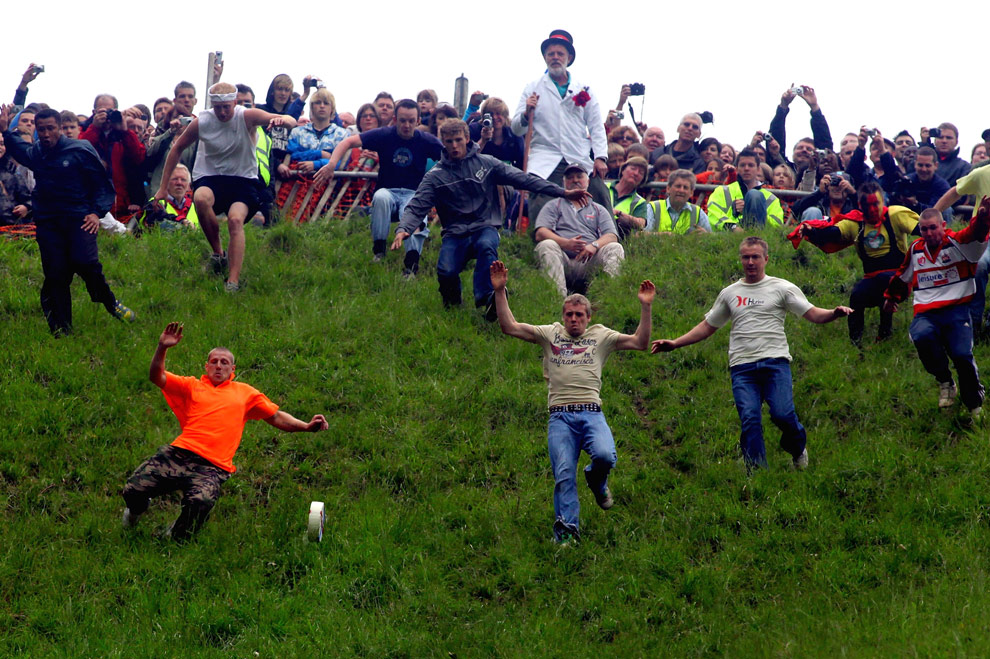
The famous "Coopers Hill Cheese Rolling and Wake" is an ancient event which takes place annually on the Spring Bank holiday in lovely Gloucestershire (UK).
Cheese rolling's origins are hazy to say the least. A common presumption is that the masochistic frolic began as a pagan festival hundreds of years ago - a celebration of the onset of summer. Other theories have it relating to age-old fertility rights, the hope of a successful harvest and even as a safeguard of the Commoner's rights for the people of Cooper's Hill.
Wherever it's origins it's hard to argue that cheese rolling is a sport for the outrageously courageous or at least the dangerously demented. Contestants in the Cooper's Hill event (between Gloucester, Stroud and Cheltenham in the Cotswolds) on the last Monday in May, stand precipitously at the top of a 300 yard hill that maintains a gradient of two in one for the most part whilst a Master of Ceremonies counts them down.
The event:
The Cooper's Hill Cheese Rolling Committee called off the event
Last year's event was cancelled after concerns about safety because of the number of spectators it attracts.
Organisers of the event at Cooper's Hill near Brock worth said 15,000 people attended 2009’s event - more than three times the site's capacity.
It is hoped the event will go ahead on the late May Bank Holiday in 2011, which will be held on a very steep hillside above Brock worth in Gloucestershire, England.
The winner of each race wins the cheese, and
The most recently champion is Chris Anderson.
Champions:
Stephen Gyde. Brock worth, Gloucester has won 20 Cheeses in 14 years (1978 to 1991).
Stephen Brain has won 18 cheeses in 17 years (1984 to 2000).
Ladies champions:
Rosemary Cooke won 3 Cheeses in the ladies races (1953 to 1956).
Amanda Turner won 3 Cheeses in the ladies races too (1981 to 1983).
Dionne Carter .Auckland, New Zealand won 3 Cheeses in the ladies races (2004 to 2006).
An event’s rules and trophies:
There are 5 downhill cheese races (one is for ladies). - Starting at 12:00 Midday.
There are 4 uphill races (Boys Under 12's, Girls Under 12's, Mens Open & Womens Open)
At the top of the hill, competitors (any number from 2 to a maximum of about 20) sit in a line and wait.
The Master of Ceremonies escorts an invited guest to the start line and helps him / her to sit on the precipitous slope, holding a 7-8lb. 'Double Gloucester' cheese.
There are Prizes for the first 3 places in each race:
Camel wrestling is now mostly restricted to the Aegean region,though it was once more widespread in Anatolia, is a Turkish sport in which two male Tülu camels wrestle in response to a female camel in heatbeing led before them.
There are an estimated 1,200 wrestling (or Tulu) camels in Turkey, bred specially for the competitions.
Origen:
It is said that the first camel wrestling competition was held in the village of Hidirbeyli in Aydin’s Incirliova Township about two centuries ago.
Although the origin of camel wrestling cannot be placed exactly, it is believed that it started during nomadic times. People interested in camel wrestling or camel owners say that the nomads used to have their camels wrestle as part of the competition between caravan owners.
Today, camel wrestling is popular mostly in Aydin. It is also seen in the cities of Izmir, Manisa, Mugla and Denizli in the Aegean region, Balikesir and Çanakkale in the Marmara region and Burdur, and Isparta and Antalya in the Mediterranean region.
Rules and the wrestling:
The proceeds earned from camel wrestling, after costs are deducted, are used for certain purposes. Neither pari-mutuel arrangements nor betting are allowed. Only male camels can wrestle in these contests, and then only those born to female camels with a single hump (dromedary or “yoz” camels) or those with double humps (Bactrian or “buhur” camels).
These camels are bred especially for wrestling, which means that the ancestors of these wrestling camels were wrestlers themselves and with a great deal of care and are trained for wrestling. The contests are held in the winter months of December, January, February and March when the tülüs are in heat. Every wrestling camel must have a name.
One day before the wrestling contest, the camels are decked out in a manner prescribed by tradition. They are then walked through the streets accompanied by music played on the drums and zurna. This is a spectacle which everyone should see at least once.
The day of the wrestling, in the wee hours of the meeting, crowds of people start flocking to the wrestling field while the camel owners try to find a good spot in the fields where their camels can face each other.
Spectators cook meat on a barbecue spit. By about 9 or 10 o’clock, the camel wrestling fans have filled the field. Street sellers set up their stands and tables around the field where they offer a wide variety of food, drinks and souvenirs, while drummers and zurna players play traditional tunes. Inspired by the music, some people dance the traditional zeybek dance.
The cazgir; the person who announces wrestlers or the wrestling camels – calls out the camels’ names. The cazgir reads poems praising each camel, adding colour to the contest. This cazgir, just as in two-legged wrestling contests, is the most important and colourful person in the competition.
Camel wrestling is held in four categories, namely Foot, Middle, Under the Head and Head.
A camel can win in any of three ways:
-by making the other camel retreat,
-by making the other camel scream,
- by making the other camel fall.
In the first road to victory, one camel sends his rival into retreat with just his fearsome appearance.
In the second, one camel overpowers the other so much that he makes him scream.
In the third, one camel cunningly manoeuvres the other to make him fall down. The winning camel goes and sits on his vanquished competitor.
Another way victory can be secured is when the camel’s owner takes his fighter out of the contest in order to prevent him from being hurt. The camel owner throws a rope on the ground indicating that he is withdrawing from the contest. The other camel is declared the winner. And sometimes the game ends in a tie.
The winning camel stands with his four feet together and greets the audience in a proud, boastful manner. He accepts a rug as his award and then exits the wrestling field. The camel which loses, on the other hand, looks embarrassed and keeps quiet.
A camel wrestles just once per day and each wrestling match lasts for 10 or 15 minutes. These rules exist to prevent the camels from being too badly hurt or even dying as well as to protect their well-being.
Trophies:
The new local governor of Bodrum, Feridun Cemal Özdemir, presented the trophies to the owners of the two final contestants who had finished “basabas” (head to head): Fernaz, owned by Nihat Altinkaya from Balikesir, and Cambazoglu Kabus, owned by Yasar Tokluoglu from Izmir.
Championship:
Held in an ancient stadium at Ephesus, near the town of Selçuk, the camel wrestling championships have drawn thousands of spectators annually. The festival usually highlights wrestling of 120 camels, but in 2001 only 96 were involve.There are 17 competitions in the 2010 - 2011 Camel League
The Bog snorkelling was born in 1976 near Llanwrtyd Wells in Wales. The Bog Snorkelling is an sport that consists of competitors completing two consecutive lenghs of a 60 yard water filled trench cut through a peat bog, in the shortest time possible. The competitors must war snorkels and flippers and complete the course without using conventional swimming strokes.
Actually the best players are Dan Morgan (the men's champion) Dineka Maguire (the women's champion and John Hilliard (the junior champion). In 2010, Dan Morgan broke a record, he achieved the time 1m 30,66” and Dineka Maguire achieved in 1 min 31,90”. Phillip John was an important competitor who won the tournament in 2002, 2003 and 2004.
The Chessboxing is an sport which combines boxing and chess. This sport was invented by Enki Bilal, a cartoonist and Iepe Rubing brought it to reality. The sport consists o 11 rounds that combine chess and boxing: 6 rounds of chess and 5 rounds of boxing. Each round of chess during 4 minutes and each round o boxing during 3 minutes. There is one minute of break between rounds. The competitor win the game if he achieves a checkmate, or if his opponent exceedes the time limit in chess round, if there is a retirement of an opponent, if there is a K.O in the boxing round. If the chess game ends in a stalement, the opponent with the higher score in boxing wins. If there is a tie score, the player win the black pieces.
The First World Chessboxing Championship was in Amsterdam in 2003, where Iepe Rubingh became the world champion and the First European Chessboxing Tournament was in Berlin in October 2005 where Tihomir Titschko won.
In 2009, in the Light Heavyweight World Championship Leo Granit Kraft won, in the Heavyweight World Championship Gianluca Sirci won and in the Middleweight World Championship Konrad Rikardson won.
The countries most interested in this sport are Germany, England, Holand, Belgium and Russia.
Mark Zuckerberg was born on 14 May of 1984 in the state of New York, (EE.UU), he belongs to a jewish family. He studied in HarvardUniversity in Massachusetts and he become a programmer and businessman better known as the creator of Facebook. To create the network he needed the help of fellow at HarvardUniversity. In 2008 he became the youngest person to appear in Forbes with a fortune of more than 4,000 billion dollars. In 2009 Facebook became a global sucess with 64 million of users.
Mark Zuckerberg is a young clever man who is only 26. I think he is a hard-working and mature person. He looks like responsable and strict with himself. Maybe he is nosy too. He seems talkative and polite in the interviews but I'm not sure. I don't think that he is a big headed or lazy man.
Well, he is a blue-eyed tall man who has got fair haired. He's slim and he's got short and curly hair. He's fair skinned too. He's not really muscular but skinny neither.
Summing up He's a common young american man physically